 SquareCaster
Moves like P-K4 and N-KB3 are written in descriptive notation, the older English-language way of recording chess. It names each file after the piece that starts on it (the K file is e, the KB file is f) and counts ranks from the side of the player who is moving. So P-K4 means “pawn to king four”: e4 when White plays it, and e5 when Black plays it.
In short:
- Files are named after pieces: QR, QN, QB, Q, K, KB, KN, KR = a to h.
- White’s ranks read as written. For Black, the algebraic rank is 9 minus the number.
- Captures name the piece taken (PxP, BxN), not the square, so check the board.
- If a short move could mean two things, the position decides.
The rest of this guide explains each step, with a worked translation and an exercise you can do on paper.
Why your book looks like this
You may have a classic by Pachman or Kotov, bought secondhand or kept for years. Descriptive notation was the usual system in English-language chess books and magazines until algebraic notation (e4, Nf3) replaced it by the early 1980s. Today FIDE “recognises for its own tournaments and matches only one system of notation, the Algebraic System” (FIDE Laws of Chess, Appendix C). The chess in your book hasn’t changed. Only the spelling has.
Files are named after pieces
In algebraic notation the files are letters a to h. In descriptive notation, each file is named after the piece that starts on it.
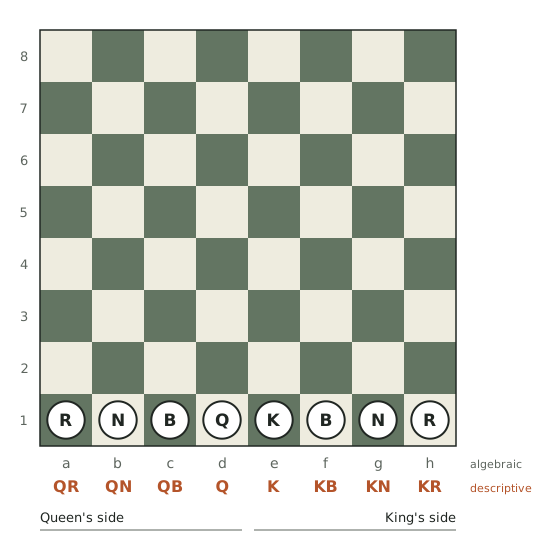
| Algebraic file | a | b | c | d | e | f | g | h |
|---|---|---|---|---|---|---|---|---|
| Descriptive name | QR | QN | QB | Q | K | KB | KN | KR |
| Said as | queen’s rook | queen’s knight | queen’s bishop | queen | king | king’s bishop | king’s knight | king’s rook |
The left half of the board (from White’s side) is the queen’s side, and every file there starts with Q. The right half is the king’s side, with K. The file names are the same for both players, because the queen and king start on the same files for both colours.
Ranks count from the mover’s side
In algebraic notation, rank 1 is always White’s back rank. In descriptive notation, rank 1 is the back rank of the player who is moving. When White moves, you count from White’s side, exactly like algebraic. When Black moves, you count from Black’s side.
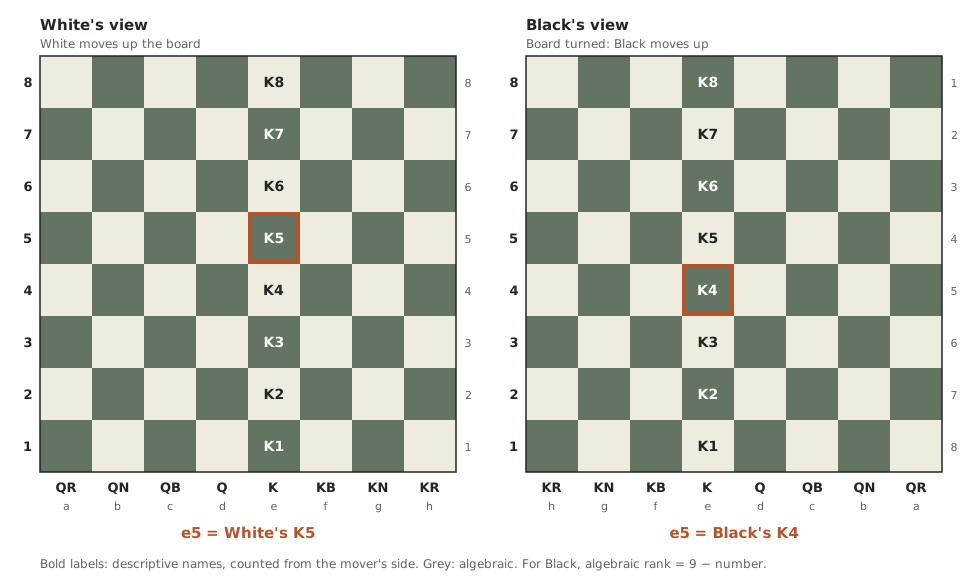
Memory aid: for Black, algebraic rank = 9 − the descriptive number.
- Black’s K4: 9 − 4 = 5, so it’s e5.
- Black’s QB3: 9 − 3 = 6, so it’s c6.
- Black’s KN1: 9 − 1 = 8, so it’s g8.
For White, the number is the rank as written: White’s K4 is e4.
Reading the moves
A descriptive move reads like a short sentence. P-K4 is “pawn to king four”.
- Piece letters: K king, Q queen, R rook, B bishop, P pawn, and N knight. Older books write the knight as Kt.
- A move: the piece, a dash (“to”), then the square. N-KB3 = knight to king’s bishop three.
- Captures name what was taken, not the square. PxP = pawn takes pawn. BxN = bishop takes knight. Look at the board to see where that happens.
- Castling: O-O (kingside) and O-O-O (queenside). Older books may write Castles, sometimes Castles KR or Castles QR to say which side.
- Check and mate: ch (or +) for check, mate for checkmate.
- Short names: when only one piece of a kind can make a move, books drop the extra letters. So you’ll see B-B4 rather than KB-QB4 when nothing else could go there.
Even older books use a few more forms:
| You may see | It means |
|---|---|
| Kt | knight |
| K. Sq. (or K Sq) | king’s square: the king’s file, first rank (K1) |
| R-K | rook to K1 (the “1” or “Sq.” is left off) |
| Castles | castling (side named, or clear from the position) |
A worked translation
Here’s a short opening written both ways. Read across each row.
| Move | Descriptive | Whose view | Algebraic |
|---|---|---|---|
| 1, White | P-K4 | White: K file, rank 4 | e4 |
| 1, Black | P-K4 | Black: K file, 9 − 4 = 5 | e5 |
| 2, White | N-KB3 | White: KB file, rank 3 | Nf3 |
| 2, Black | N-QB3 | Black: QB file, 9 − 3 = 6 | Nc6 |
| 3, White | B-N5 | White: an N file, rank 5 | Bb5 |
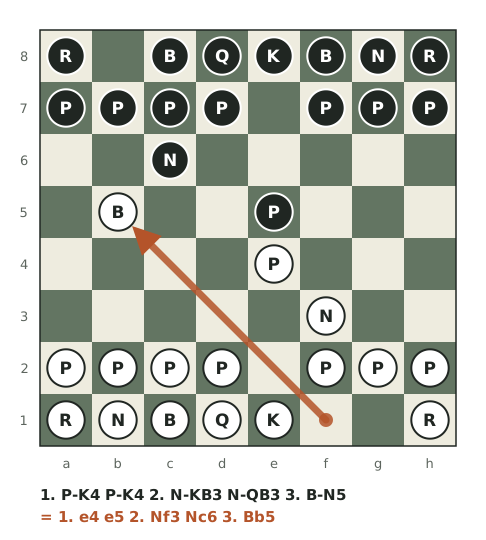
Both players’ first moves are written P-K4, even though one pawn lands on e4 and the other on e5.
Move 3, B-N5, doesn’t say which N file: QN5 (b5) or KN5 (g5). It doesn’t need to, because only one bishop can reach either square. The bishop on f1 can go to b5; the bishop on c1 is still blocked by the d2 pawn, so it can’t reach g5. (A knight could go to g5, but that would be written N-N5.) So B-N5 can only be Bb5.
The most common mistake
The usual slip is reading Black’s moves from White’s side. If you translate Black’s 1…P-K4 as e4, the square is already taken and the game stops making sense two moves later.
The fix is a habit: before translating any move, ask “whose move is this?” If it’s Black’s, do the 9 − number step every time, even when it feels obvious. If a translated move lands on an occupied square or a square the piece can’t reach, this is almost always why.
When it gets ambiguous
Sometimes the short form fits more than one move. Three habits help:
1. Ask which moves are legal. Like B-N5 above, most short forms only fit one move. Look at the pieces that could make it.
2. Watch for PxP with two choices. Take 1. P-Q4 P-Q4 2. P-QB4 P-K3 3. N-QB3 P-QB4 4. PxP (in algebraic: 1. d4 d5 2. c4 e6 3. Nc3 c5 4. cxd5). Now Black has two pawn captures: the e6 pawn can take on d5, and the c5 pawn can take on d4. Careful books write KPxP (the king’s pawn takes, so 4…exd5) or BPxP (the bishop’s pawn takes, so 4…cxd4). If your book just says PxP, use the notes or the next moves to work out which one happened.
3. Read slash and bracket forms. When a short name isn’t enough, books add a square: BxN/B6 means “bishop takes the knight on (the mover’s) B6”, and R(Q1)-Q3 means “the rook on Q1 moves to Q3”.
If you’re still unsure, stop translating and look at the board. The position almost always makes the move clear.
Try it on paper
Translate these moves into algebraic. Write your answers down before you check, and remember whose move each one is.
1. P-Q4 N-KB3 2. P-QB4 P-K3 3. N-QB3 B-N5
Answers: 1. d4 Nf6 2. c4 e6 3. Nc3 Bb4.
Black’s 3…B-N5 is the one to watch. From Black’s side, N5 is rank 9 − 5 = 4, so it’s b4 or g4. Only the f8 bishop can get there (the c8 bishop is blocked by the e6 pawn), so it’s Bb4. If you wrote Bb5 or Bg5, you counted from White’s side: that’s the common mistake above.
What to do with your book
You don’t have to choose forever. The practical options:
- Play through it on a board. Set up a real board, or open a free analysis board such as Lichess’s, and make each move as you translate it in your head. You read the descriptive move; you play the algebraic one. After a chapter or two, many readers stop translating at all.
- Pencil in the algebraic move. For a game you’ll study closely, write the algebraic version in the margin once. Translate by hand, using the position, rather than trusting a converter: old books contain misprints, and a person spots them more easily than a program.
- Know when to stop. If one move resists you for more than a minute, set up the position and try each legal move that fits the description. Usually only one does.
Spanish-language books use different letters. The pieces are R (rey, king), D (dama, queen), T (torre, rook), C (caballo, knight), A (alfil, bishop) and P (peón, pawn), and the rank comes before the file. So P4R is “pawn to king four”, the same move as P-K4 (e4 for White). The files are TD, CD, AD, D, R, AR, CR, TR. The same two ideas apply.
Translation gets quicker when the algebraic square names come without thinking. Any free coordinate trainer, such as the one on Lichess, helps with that.
Practise this on SquareCaster
Once you’ve translated an opening, you can play it through in algebraic in Chess Practice: you write each move and the computer plays the other side. It’s untimed, with no clock and no rating, and it’s free with no account.
Related guides: Garden Raid: a free chess coordinates game · How to fill in a chess scoresheet at your first tournament
The rule quoted is from the FIDE Laws of Chess taking effect from 1 January 2023, Appendix C. All boards and tables here are our own.