 SquareCaster
To keep score at a chess tournament, write every move, yours and your opponent’s, on the scoresheet in algebraic notation: one numbered row per move, White’s move on the left and Black’s on the right. The routine is move, press the clock, write. Never write a move before you play it.
Online, the move list writes itself. Over the board, it’s your job, and for many people moving from online to in-person chess it’s the part they worry about most. The good news is that it’s a short, repeatable routine, and small slips happen to everyone.
This guide follows the FIDE Laws of Chess in effect from 1 January 2023. National federations and individual events can have their own rules, so check your event’s rules or ask the arbiter before round one.
Why tournaments ask you to write the moves
In a standard (slower) FIDE game, each player must record both players’ moves, “move after move, as clearly and legibly as possible”, in algebraic notation (Article 8.1.1). There are three practical reasons:
- It’s the official record. If there’s a question about a draw claim or how many moves have been played, the arbiter looks at the scoresheets.
- It settles disputes. When both players have a clear record, a mix-up is much easier to sort out fairly.
- You get your game back. After the round you can type the moves into an analysis board and see what happened. A lot of players find this the best part.
One thing that surprises online players: under FIDE’s rapid rules, “players do not need to record the moves” (Appendix A.2). Rapid means more than 10 and less than 60 minutes each. You can still ask the arbiter for a scoresheet if you’d like to keep score. Slower games are where scoring is required, so check the time control on the event page.
What a scoresheet looks like
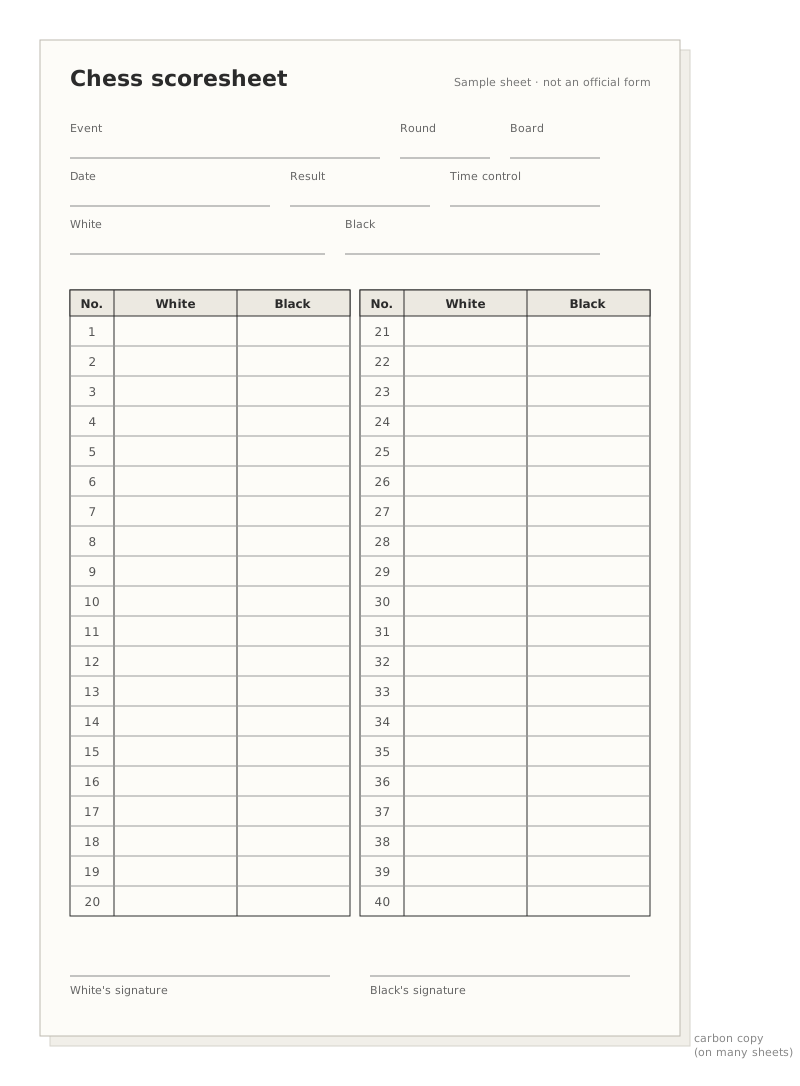
Most scoresheets share the same layout:
- A header for the event, round, date, both players’ names and, later, the result. At the end of the game both players sign both scoresheets to confirm the result (Article 8.7).
- A move number column, usually running to 60 or more.
- A White column and a Black column. Each row is one full move: White’s move on the left, Black’s reply on the right.
- A carbon copy. Many scoresheets have a copy layer underneath, so one copy goes to the organiser and you keep the other. Press firmly enough for it to come through.
The scoresheet belongs to the organiser (Article 8.3), and it should stay where the arbiter can see it during the game (Article 8.2). Use the sheet the event gives you.
The symbols you need
FIDE’s notation (Appendix C) is short, and most of it you’ll recognise from online move lists.
- Squares are a letter (a–h) then a number (1–8): e4, f3, d5. If that still takes a moment, the guide to reading chess coordinates covers it.
- Pieces are capital letters: K king, Q queen, R rook, B bishop, N knight. Pawns get no letter, so a pawn to e4 is just e4.
- A capture can be marked with x: Bxe5. For a pawn capture, write the file it came from: dxe5.
- Check is + and checkmate is #. FIDE treats x, + and # as optional, but they make your sheet easier to read later.
- Castling is 0-0 (kingside) and 0-0-0 (queenside) in FIDE’s Laws. Many apps and books print the same moves with the letter O: O-O and O-O-O. Both mean the same thing.
- Promotion in FIDE’s Laws is the pawn move followed by the new piece: d8Q. You’ll often see d8=Q in apps and books. Same move.
- A draw offer is written as (=) next to the move, on both players’ sheets (Article 8.1.5).
If two of the same piece can reach a square, add the file (or rank) the moving piece starts from. In the sample below, Nbxd2 means “the knight on the b-file captures on d2”, because the knight on f3 could also have gone there.
The routine: move, clock, write
Practise this order until it’s automatic:
- Make your move on the board.
- Press the clock.
- Write your move on the scoresheet.
- When your opponent moves, write their move too.
There’s one firm rule: “it is forbidden to record the moves in advance” (Article 8.1.2), apart from certain draw claims you’re unlikely to meet in your first event. So don’t write your planned move and then play it. Play it, then write it.
There’s also some flexibility. “A player may reply to his/her opponent’s move before recording it, if he/she so wishes. He/She must record his/her previous move before making another” (Article 8.1.3). If you know your reply straight away, you may move first and fill in both moves afterwards, but your own previous move must be on the sheet before you make your next one.
Writing on your opponent’s time, right after you press the clock, is normal and costs you nothing. Most players settle into a rhythm within a few moves.
Playing Black? Still write from White’s side
The board’s coordinates never flip. a1 is always White’s queenside corner, whichever colour you have. As Black, the squares nearest you are on ranks 7 and 8, and your knight’s first move might be Nf6 or Nc6. You write exactly the same square names White would.
If naming squares from Black’s side makes you hesitate, that’s normal for online players, who usually see the board turned around for them. A few minutes of square-naming practice from both sides helps.
A short sample game
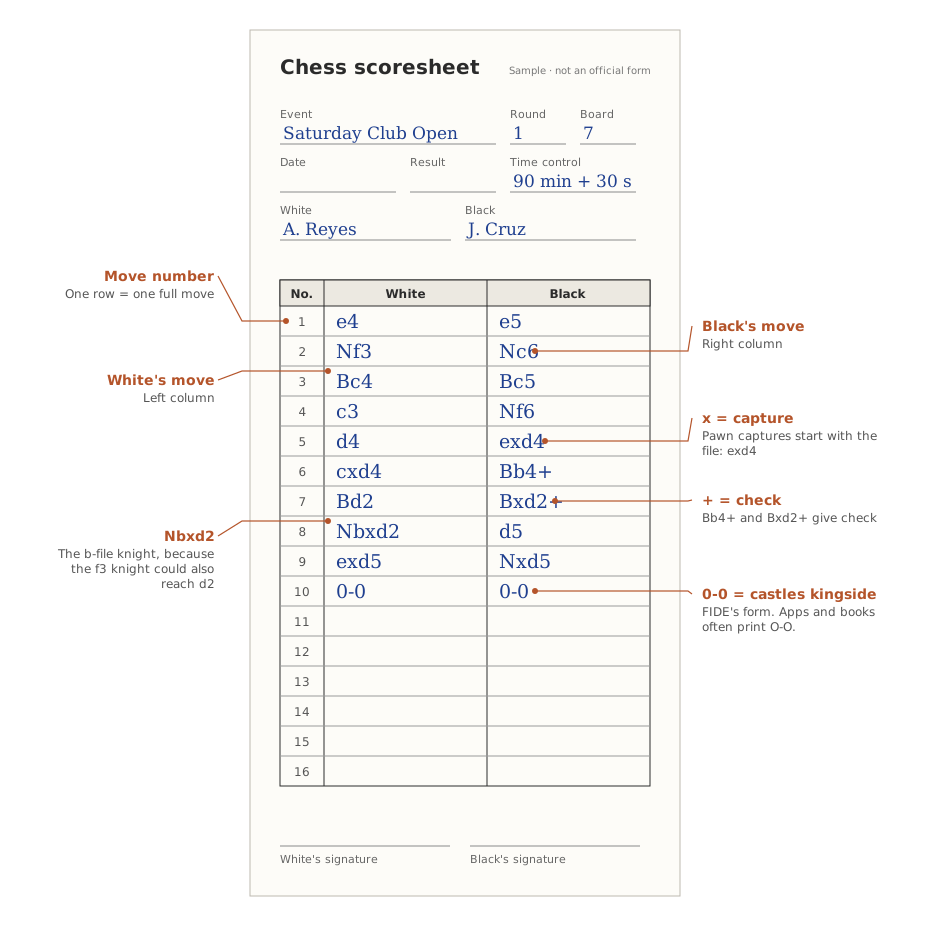
| No. | White | Black |
|---|---|---|
| 1 | e4 | e5 |
| 2 | Nf3 | Nc6 |
| 3 | Bc4 | Bc5 |
| 4 | c3 | Nf6 |
| 5 | d4 | exd4 |
| 6 | cxd4 | Bb4+ |
| 7 | Bd2 | Bxd2+ |
| 8 | Nbxd2 | d5 |
| 9 | exd5 | Nxd5 |
| 10 | 0-0 | 0-0 |
In ten moves you’ve used pawn moves, piece moves, pawn and piece captures, check, a “which knight?” letter and castling. That’s most of what you’ll write in a real game.
When it goes wrong
Everyone slips sometimes. What matters is staying calm and knowing who to ask.
You skipped a move or wrote the wrong square. Don’t guess, and don’t try to sort it out with your opponent mid-game. Ask the arbiter what you may do at this event. A quiet raised hand is enough; arbiters deal with this all the time.
You’re short on time. If you have less than five minutes on your clock and you’re not getting an extra 30 seconds or more per move, you’re “not obliged to meet the requirements of Article 8.1.1” for the rest of that period (Article 8.4). You may stop writing and just play. With an increment of 30 seconds or more, you keep scoring all the way.
Catching up afterwards. If you stopped writing under 8.4, Article 8.5 explains how to fill the gap:
- If only you stopped scoring, then “as soon as either flag has fallen” you must update your scoresheet completely before moving a piece. If it’s your move, you may borrow your opponent’s scoresheet, but must return it before moving (8.5.2).
- If neither player kept score, the arbiter or an assistant should try to be present and keep score. After a flag falls, the arbiter pauses the clock and both players update their sheets (8.5.1).
If any of this is unclear on the day, ask the arbiter. That’s what they’re there for.
Practise at home first
You don’t need a tournament to rehearse:
- Print or draw a simple three-column sheet (No. · White · Black).
- Play a slower online game and write each move on paper as it happens, including your opponent’s.
- Afterwards, compare your sheet with the site’s move list. Circle anything that doesn’t match.
- Repeat for a few games, at least once as White and once as Black.
The mismatches show you what to watch for: maybe you mix up c and e, or forget the x on captures. Writing also gets easier when square names come without thinking; any coordinate trainer helps, such as the free one on Lichess.
Practise this on SquareCaster
If you’d like to practise writing moves on screen, Spell Duels shows a move on the board and asks you to write it in notation, from first moves and pawn captures to check and castling. There’s no timer, and the first seven arenas are free with no account. When you want a whole game, Chess Practice lets you write every move against the computer, with no clock, free.
Bring a pen you like, arrive a little early, and enjoy your first game on a real board.